
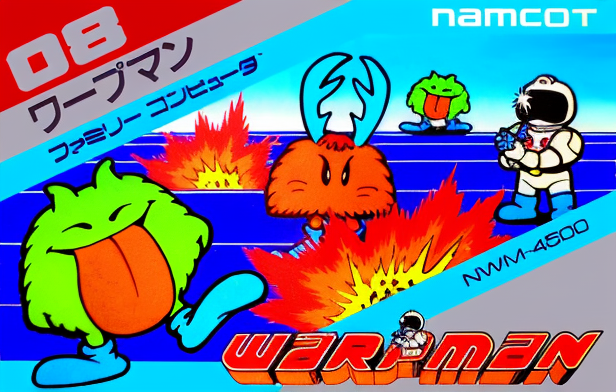
Warpman: Namco Classic Famicom Title
Warpman is a creative maze chase action title developed and ported to the Famicom by Namco, conceived as a thematic and mechanical evolution of Pac-Man. Building upon the single-screen labyrinth formula popularised by Pac-Man, Warpman introduces teleportation warp portals and altered enemy behaviour systems, creating fresh tactical challenge while retaining accessible maze-evasion fundamentals. Released relatively early within Namco’s Famicom third-party lineup, the title demonstrates Namco’s willingness to iterate on its own landmark gameplay templates rather than simply rehashing identical mechanics for successive releases.
Every stage consists of a closed rectangular maze filled with edible dot items. Players control Warpman, tasked with consuming every dot to complete the level. Multiple hostile enemy creatures patrol maze corridors continuously, and direct contact results in a lost life. Larger flashing power pellets temporarily reverse enemy behaviour, turning foes vulnerable so Warpman can hunt them for bonus points during the limited effect window. The defining new feature is paired warp portals positioned at opposite maze locations; entering one instantly transports the character to the matching portal, enabling rapid long-distance traversal to escape surrounding enemies.
Enemy artificial intelligence follows differentiated patrol patterns similar to Pac-Man, though movement speeds and pursuit aggression are rebalanced to accommodate warp travel. Skilled players learn to utilise portal pairs to set up escape routes, lure enemies into distant sections of the maze and create safe windows to clear clustered dot groups. Poorly timed warp usage can accidentally transport Warpman directly into waiting enemy patrols, adding constant risk-reward tension to every portal decision.
After clearing all maze dots, the stage resets with increased difficulty. Enemy movement speeds rise, and power pellet vulnerability duration shortens on repeated cycles, making extended survival runs progressively harder. Bonus fruit items spawn periodically near the maze centre, granting extra score points if collected quickly before vanishing, supporting high-score competitive play popular in Famicom household environments.
Namco’s Famicom port preserved core maze layout, enemy AI and warp portal functionality. Minor sprite and colour adjustments were implemented to suit Famicom display hardware, while clear visual separation between playable character, enemies, dots and portals maintained fast-paced readability. Looping background melodies and discrete sound cues for dot consumption, portal travel and power activation were adapted from the arcade original for the Famicom sound chip.
Historically, Warpman illustrates how Namco explored expansions to the Pac-Man maze chase formula without abandoning the core accessible loop. The warp portal mechanic added a strategic dimension absent from the original Pac-Man, inspiring maze game designers to incorporate fast travel mechanics in numerous later productions across hardware generations.
For contemporary Famicom retro collectors, Warpman operates as a refreshing variant of classic maze chase gameplay. Fans of Pac-Man will recognise the foundational structure while discovering new tactical possibilities enabled by teleportation portals. Simple to learn yet demanding for high-score mastery, Namco’s Warpman remains an enjoyable underrated maze action title within the extensive Namco Famicom arcade port library.