
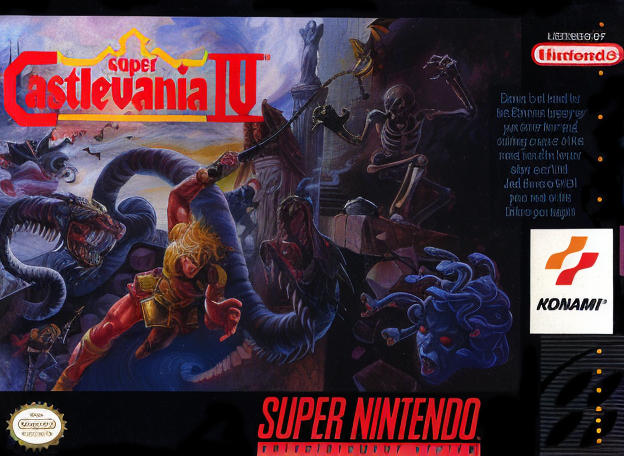
Akumajou Dracula (1991)
Akumajou Dracula, known in the West as Super Castlevania IV, is a legendary action-platformer developed and published by Konami for the Super Famicom, released on October 31, 1991. It is the fourth mainline entry in the Castlevania series and a reimagining of the original 1986 NES classic. The game follows Simon Belmont, the legendary vampire hunter, on a quest to enter Dracula's cursed castle and defeat the dark lord once and for all. This installment is celebrated for its technical achievements, innovative control scheme, and atmospheric presentation, making it one of the most beloved games in the franchise.
Gameplay and Revolutionary Controls
Akumajou Dracula introduced a major gameplay evolution: the ability for Simon to whip in all eight directions, a significant improvement over the earlier entries where whipping was restricted to a horizontal line. This allowed for more dynamic combat and better enemy engagement. Simon could also swing his whip in a circular motion to deflect projectiles, adding a defensive layer to the action. The game also introduced the ability to jump and control trajectory mid-air, giving players greater precision during platforming segments. The whip was upgradeable through item drops, with the "Chain Whip" and "Thorn Whip" providing longer reach and additional damage.
The game features 12 stages, each with a distinct gothic theme, ranging from the haunted forest and underground catacombs to the iconic clock tower and Dracula's throne room. The level design is non-linear in places, with multiple paths and hidden areas that encourage exploration. The game's difficulty is challenging but fair, with a well-balanced curve that rewards patient play and pattern recognition. The game also includes a password save system, allowing players to continue their progress across multiple sessions.
Technical Excellence and Musical Masterpiece
Akumajou Dracula is renowned for its technical achievements on the Super Famicom. The game utilized the console's Mode 7 scaling and rotation effects to create pseudo-3D backgrounds and dynamic camera angles, including a rotating room effect that was groundbreaking at the time. The visual design was dark, atmospheric, and richly detailed, with intricate sprite work and fluid animations that brought the castle to life. The soundtrack, composed by Konami's legendary sound team (including Masanori Adachi and Taro Kudo), is widely considered one of the greatest video game soundtracks of all time, featuring haunting melodies, dramatic orchestral pieces, and the iconic theme "Vampire Killer" reimagined with 16-bit symphonic grandeur.
The game received universal acclaim upon release and is often cited as one of the best games on the Super Famicom. It sold over 1 million copies worldwide and cemented the Castlevania series as a cornerstone of the action-platformer genre. The game's influence can be seen in later entries, including Castlevania: Symphony of the Night, which expanded on the exploration elements introduced here. Trivia: The game's Japanese title, "Akumajou Dracula," directly translates to "Demon Castle Dracula," and the Western title Super Castlevania IV was chosen to emphasize its connection to the series and its improved gameplay.