
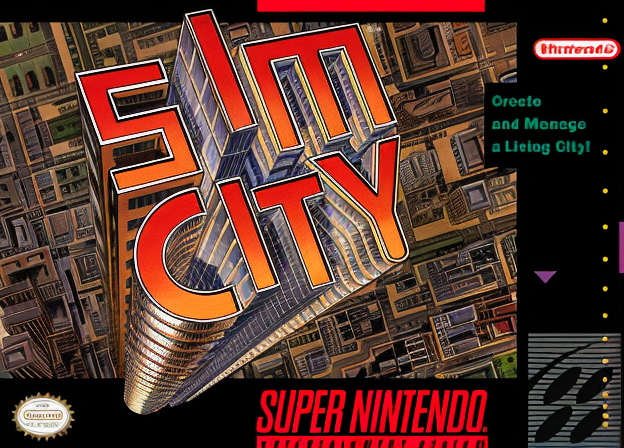
SimCity (1991 – SFC Port)
SimCity is a pioneering city-building simulation game originally designed by Will Wright and published by Maxis for personal computers in 1989. The Super Famicom port was published by Nintendo in Japan on March 8, 1991, making it one of the earliest console adaptations of a complex PC strategy game. Nintendo's involvement brought the game to a broader audience, and their version included unique features like a simplified interface tailored for the gamepad, colorful and charming graphics, and the inclusion of Bowser and other Nintendo-themed disasters as playful easter eggs, blending the serious simulation genre with Nintendo's signature whimsy.
Core City-Building Mechanics
SimCity challenges players to construct and manage a thriving metropolis from scratch. Starting with an empty plot of land, players zone areas for residential, commercial, and industrial development, build infrastructure like roads, power plants, water pipes, and rail networks, and manage the city's budget by adjusting taxes and funding for public services. The game simulates complex economic and social systems: residential zones need power and jobs, commercial zones require customers, and industrial zones demand efficient transport links. Balancing these competing demands while maintaining a positive budget and responding to emergencies is the heart of the gameplay.
Players must also handle various disasters that can strike their city, including earthquakes, floods, fires, and even monster attacks. In the Nintendo version, a particularly memorable feature is the ability to summon Bowser to wreak havoc on the city, a playful nod to the company's flagship franchise. The game features multiple scenarios with specific goals, such as achieving a target population or generating a certain level of revenue, and a free-build sandbox mode for creative players. The interface, while simplified, offers a surprising depth of control, allowing players to view the city in different overlays, such as population density, traffic flow, and land value, mirroring the complexity of its PC counterpart.
The Super Famicom version of SimCity received critical acclaim for successfully translating the complex simulation genre to consoles, selling over 1.5 million copies worldwide. It introduced a new generation of players to the joys of simulation gaming and laid the groundwork for future city-building games on consoles, including later entries in the SimCity franchise and other titles like SimCity 2000. Nintendo's port also influenced Will Wright to develop SimCity for SNES as his preferred version due to the intuitive controller design. The game remains a landmark example of how thoughtful adaptation can make complex strategy games accessible without sacrificing depth.