
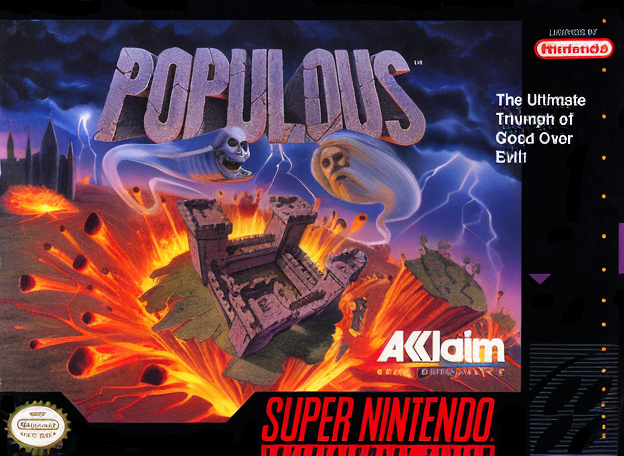
Populous (1989 – SFC Port 1990)
Populous is a landmark real-time god simulation game originally designed by Peter Molyneux and released for the Amiga and PC in 1989. The Super Famicom version was published in Japan on December 21, 1990 by Imagineer, marking one of the earliest console ports of a complex computer strategy game. Widely considered the first true "god game," Populous places the player in the role of a deity who must guide their chosen civilization (the "Followers") to conquer and convert the followers of an opposing god (the "Enemy") across dozens of procedurally generated flat or spherical worlds. The game's core philosophy is indirect control: rather than commanding units directly, the player manipulates the terrain itself, using divine powers to shape the world and influence their followers' behavior through subtle environmental changes.
Core Gameplay and Divine Mechanics
The game is presented in an isometric perspective, and each level features a large landmass divided into square tiles with varying elevations, including plains, hills, mountains, and water. The player's Followers automatically build homes, generate new followers, and expand their territory by climbing and crossing terrain. However, their movement is limited by geography—they cannot climb steep cliffs or cross deep water. To aid them, the player wields a "hand" cursor that can raise or lower landmasses using two primary powers: "Land Raise" (to create hills and bridges) and "Land Lower" (to create valleys and flood areas). By carefully sculpting the terrain, players can create pathways for their followers, isolate enemy settlements by flooding them, or create defensive natural barriers.
The ultimate goal is to convert the enemy population to your faith. This is achieved by building a spiritual "spiritual energy" gauge, which fills up as your followers multiply and build new structures. Once enough energy is accumulated, the player can cast devastating "Armageddon" spells that wipe out enemy units, or use "Earthquake" to reshape the battlefield dramatically. The game's AI is surprisingly adaptive: the enemy god will actively counteract your moves, raising their own land and casting counter-spells, creating a back-and-forth struggle that demands strategic foresight and quick reflexes. Each level offers a unique topography and challenge, with the number of followers and the starting terrain conditions varying widely, ensuring no two playthroughs are identical.
Porting Challenges, Reception, and Legacy
The Super Famicom port of Populous was a technical marvel for its time, attempting to compress the massive computational demands of the original Amiga version into the SNES's limited 16-bit hardware. The port was handled by Imagineer and retained the core gameplay while simplifying the interface to accommodate the gamepad, using the D-pad for cursor movement and shoulder buttons for power selection. Although the console version suffered from slower frame rates and reduced viewport, it was still praised for its ambitious scope and addictive "one more turn" gameplay, earning it a strong cult following in Japan. The game's influence is immeasurable: Populous spawned an entire genre of god simulation games, including its own sequels (Populous II: Trials of the Olympian Gods) and spiritual successors like Black & White, Spore, and Godus. It also established Peter Molyneux as one of the most innovative game designers of his era, earning him a BAFTA Fellowship award later in his career. Interestingly, the game's box art in Japan featured a stylized depiction of a Buddhist deity, reflecting the local cultural adaptation of the game's religious themes. Populous remains a must-play for strategy enthusiasts, showcasing how imaginative game design and simple mechanics can create profound emergent gameplay experiences that transcend hardware limitations.