
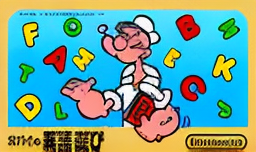
Popeye no Eigo Asobi: Nintendo Classic Famicom Title
Popeye no Eigo Asobi, translated as Popeye’s English Play, is a unique educational edutainment title released exclusively for the Japanese Famicom by Nintendo, designed to teach basic English vocabulary to young children through interactive gameplay. Part of Nintendo’s early 80s educational software lineup, this title leverages the popular Popeye cartoon license to transform rigid textbook memorization into engaging home entertainment, broadening the Famicom’s functionality beyond pure gaming and establishing the console as a versatile household learning device.
The game’s core design merges kid-friendly mini-game mechanics with structured English vocabulary training, focusing entirely on beginner-level words including animals, colors, foods, household objects, and everyday items tailored for Japanese elementary students. Instead of boring repetitive drills, players complete interactive challenges such as picture-to-word matching, spelling arrangement, and visual vocabulary identification. Every correct answer triggers cheerful character animations featuring Popeye, Olive Oyl, and Bluto, creating positive reinforcement that keeps young learners motivated without the stress of traditional studying.
Multiple selectable game modes offer varied learning exercises to prevent monotony. Players can match illustrated objects to correct English spellings, identify corresponding pictures for displayed English words, or arrange scattered alphabet letters to form complete vocabulary terms. The game features no punitive game-over mechanics for incorrect answers, allowing children to experiment freely, learn through trial and error, and build confidence without frustration. This gentle learning design was revolutionary for 1980s console educational software.
Visually, the title uses bright, cartoon-accurate Popeye character sprites and clean illustrations that perfectly replicate the classic animated series art style. The interface is extremely simple and child-friendly, with clear visual separation between learning prompts, answer choices, and character animations. All educational content focuses purely on basic English acquisition, while Japanese menu text guides navigation for parents and young players unfamiliar with English interfaces.
Audio design features upbeat, cheerful background music and encouraging positive sound effects for correct responses. Harsh error tones are intentionally omitted to maintain a calm, supportive learning atmosphere. Familiar Popeye musical themes create a comforting, playful environment that children associate with fun rather than formal schoolwork, drastically reducing learning resistance.
Contextually, Popeye no Eigo Asobi filled a major market niche in 1980s Japan, where home English learning tools were limited and expensive. Nintendo capitalized on existing household Famicom hardware to deliver affordable supplementary education software, allowing parents to justify console purchases as both entertainment and educational equipment. Alongside Donkey Kong Jr.’s math learning game, it formed Nintendo’s core early edutainment lineup targeting developing young academic skills.
Exclusive to the Japanese Famicom market and never officially localized overseas, this title remains a rare, unique artifact of early Japanese console edutainment design. It demonstrates Nintendo’s diverse development range beyond action games, showcasing the company’s ability to design thoughtful, age-appropriate educational software with careful attention to child psychology and learning efficiency.
For modern retro collectors and gaming historians, Popeye no Eigo Asobi is a highly valuable overlooked classic. It documents the early era of video game education design, balancing fun, accessibility, and educational purpose flawlessly. As a one-of-a-kind licensed educational Famicom exclusive, it holds unique cultural and historical significance within Nintendo’s vast 8-bit library.