
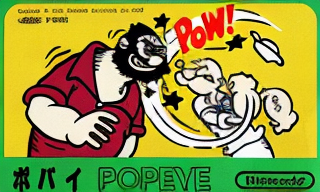
Popeye: Nintendo Classic Famicom Title
Popeye is a classic arcade-to-Famicom port developed and published by Nintendo, based on the iconic licensed cartoon character of the same name, holding a uniquely important place in Nintendo’s early development history. Originally intended to be Nintendo’s first arcade game before licensing complications led to the creation of Donkey Kong, Popeye finally released as a fully polished arcade title shortly after Donkey Kong’s breakthrough success, later receiving an excellent home conversion for the Japanese Famicom console. This title represents the alternate development path Nintendo nearly took, making it a fascinating historical artifact alongside the company’s original IP classics.
Gameplay centers on objective-based platform navigation set across harbor-themed stages, faithfully following the classic Popeye cartoon lore. Players control Popeye, tasked with catching floating hearts thrown by Olive Oyl while constantly evading the relentless pursuit of the villain Bluto. Hearts slowly drift downward across multi-level platforms, and players must intercept each one before it falls off-screen to progress the stage. Bluto continuously patrols each level, chasing Popeye with aggressive movement patterns that grow faster and more unpredictable as stages advance. A single direct collision with Bluto results in a lost life, creating constant pressure and tension throughout play.
The game’s signature mechanic revolves around collectible spinach cans that periodically spawn on each stage, directly referencing Popeye’s iconic super strength ability from the cartoons. Collecting spinach grants temporary invincibility and a powerful forward dash attack that knocks Bluto off the screen, clearing the immediate threat and granting brief breathing room. This mechanic perfectly integrates source material lore into core gameplay, avoiding the shallow licensed-game cash-in design common in 1980s tie-in titles.
Additional environmental hazards further deepen stage challenge, including flying seagulls, swinging anchor chains, and rolling barrels that traverse platform surfaces. These dynamic threats force players to maintain constant awareness of multiple danger sources while focusing on heart collection and Bluto evasion. Stage completion requires gathering a set number of hearts, and repeated play loops escalate all difficulty variables, increasing enemy speed, hazard frequency, and heart fall velocity for advanced players.
The Famicom port faithfully replicates every core system from the arcade original with careful hardware optimization. Sprite animations, character movement physics, Bluto’s patrol logic, and spinach power-up duration are preserved perfectly. The Famicom color palette is skillfully adjusted to maintain clear visual contrast between Popeye, Bluto, Olive Oyl, and stage hazards, ensuring fast-paced gameplay remains visually readable. All original arcade sound effects and the beloved Popeye theme song are adapted to the Famicom sound chip, delivering authentic nostalgic audio quality.
As a licensed title in Nintendo’s early Famicom lineup, Popeye broadened the console’s appeal beyond original game fans. The globally recognized cartoon character attracted casual players, families, and younger audiences familiar with Popeye’s animated series, helping Nintendo secure a wider household user base. It proved that Nintendo could masterfully develop both original IP and high-quality licensed game experiences with respectful, lore-accurate design.
Today, Popeye remains a highly regarded hidden gem in the early Famicom library. Overshadowed slightly by Donkey Kong’s historical fame, it nevertheless offers tight, polished arcade action with unique objective-based platforming gameplay distinct from Nintendo’s other 8-bit classics. For collectors and retro gaming historians, Popeye serves as a critical piece of Nintendo’s pre-Mario development timeline, preserving a key chapter of the company’s arcade and Famicom evolution.