
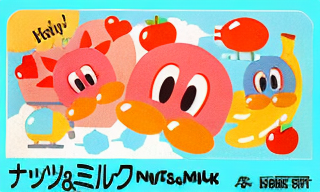
Nuts & Milk: Hudson Soft Classic Famicom Title
Nuts & Milk is a charming maze-platform hybrid developed and published by Hudson Soft for the Famicom console, debuting relatively early within the platform’s software lineup and establishing Hudson’s reputation for creative, accessible arcade-style action on Nintendo’s 8-bit hardware. Originally created as an arcade game before transitioning to the home market, Nuts & Milk blends labyrinth navigation, platform jumping and item collection wrapped within a simple lighthearted romantic narrative. The title would become one of Hudson’s better-known early Famicom releases, preceding massive hits such as Bomberman and Adventure Island and showcasing the developer’s talent for crafting addictive score-chasing arcade experiences suitable for home play.
Players assume control of Milk, a small pink creature on a mission to reach his beloved Nuts, trapped somewhere within each enclosed single-screen stage. Every level forms a continuous interconnected maze constructed from platforms, ladders and jump gaps. The primary objective is to locate and make contact with Nuts to complete the stage. However, hostile enemy creatures patrol every screen, and direct contact results in a lost life. Milk possesses no offensive abilities, meaning survival depends entirely on evasion, careful route planning and precisely timed jumps to avoid roaming opponents.
A defining mechanic allows Milk to pick up and carry fruit items scattered across each stage. Carried fruit can be thrown horizontally to temporarily stun enemies, creating safe passage through otherwise dangerous sections of the maze. Fruit supplies are limited, forcing players to conserve resources and weigh when to deploy stun attacks. Some stages contain multiple fruit pickups, while others offer very few, encouraging careful resource management throughout exploration. After completing each stage, the game advances to the next maze layout, and enemy movement speed gradually increases as cycles repeat, raising overall challenge for extended play sessions.
Over fifty unique stage layouts are built into the cartridge, delivering substantial variation in maze shape, enemy patrol paths and fruit placement. Later layouts feature tighter corridors, narrower jump gaps and multiple overlapping enemy patrol routes that demand superior situational awareness. Two distinct play modes expand replay value: standard single-player arcade mode focused on high-score competition, and a simultaneous two-player mode that allows a second participant to control a rival character. Multiplayer sessions enable friendly competitive maze racing, creating entertaining local social play ideal for family gatherings.
Visual presentation uses bright, colourful cartoon-style sprites consistent with Hudson Soft’s whimsical art direction during the mid 1980s. Distinct visual separation exists between playable characters, enemy creatures, platform surfaces and background elements, ensuring fast-paced navigation remains visually readable. Audio consists of cheerful looping background melodies and concise sound effects triggered by jumping, fruit collection, throwing items and stage completion, sustaining a light, playful atmosphere throughout gameplay.
Commercially, Nuts & Milk helped establish Hudson Soft as a reliable third-party developer for the Famicom. At a time when the platform’s third-party catalogue was still expanding, Hudson delivered polished arcade conversions and original creations that complemented Nintendo’s first-party lineup. The accessible control scheme and simple objective lowered entry barriers for younger players, while intricate maze layouts and enemy patterns provided long-term challenge for dedicated high-score competitors.
For contemporary Famicom retro enthusiasts, Nuts & Milk remains an underappreciated gem. It merges maze exploration and platforming in a fashion rarely seen within other 8-bit titles, creating a gameplay loop distinct from Nintendo’s first-party classics. The two-player racing mode offers unique social retro gaming opportunities, and the large roster of unique stages prevents rapid repetition. As one of Hudson Soft’s formative Famicom releases, Nuts & Milk occupies a meaningful place within the history of third-party development on Nintendo’s iconic 8-bit home console.