
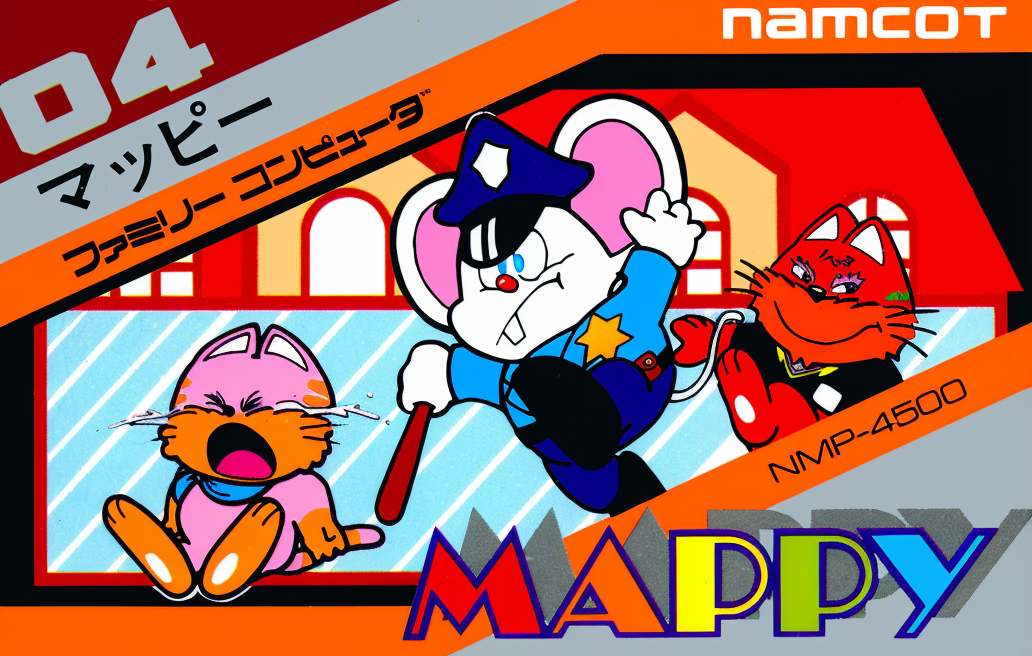
Mappy: Namco Classic Famicom Title
Mappy is a charming arcade maze-action title developed by Namco and ported to the Famicom home console, first debuting in coin-operated arcades before reaching Japanese households on Nintendo’s 8-bit hardware. Created as a lighthearted alternative to more hostile arcade chase games, Mappy casts players as a police mouse tasked with recovering stolen valuables inside a multi-story mansion occupied by criminal cat gang members. The game blends vertical navigation, item collection and evasive enemy pursuit, building a gentle cartoon-style action experience suitable for younger players while still offering sufficient challenge to engage veteran arcade enthusiasts. As one of Namco’s popular mid-1980s arcade exports, the Famicom conversion strengthened Namco’s varied third-party lineup on the Famicom platform.
The playfield consists of a large multi-level mansion connected by horizontal floors, stairways and trampoline bounce pads. Players control Mappy the police mouse, whose objective is to retrieve every stolen treasure item scattered across each floor. Valuables include jewellery, paintings and musical instruments, all left behind by the criminal cat gang known as the Meowkies. Two main enemy types patrol continuously: regular Meowkie cats and the large boss cat Goro. Direct contact with any cat results in a lost life, and Mappy has no permanent attack weapons, relying on environmental tools to evade or temporarily disable pursuers.
Trampolines form the most important traversal mechanic. Stepping onto a trampoline launches Mappy upward between floors, though repeated bounces on the same trampoline reduce jump height gradually. Players can also activate closed doors to create temporary barriers blocking cat movement. A special flashing door releases a shockwave that stuns all nearby enemies for a short window, creating safe opportunities to collect clustered treasure. Mastery requires planning routes to gather valuables while utilising doors and trampolines to avoid being cornered by multiple pursuing cats.
Once all treasure items are collected, the stage completes and difficulty rises on the next cycle. Enemy movement speed increases, and cats pursue Mappy more aggressively. Bonus fruit items occasionally spawn in central areas, awarding extra score points if collected quickly. High-score players memorise optimal treasure collection sequences to minimise travel distance and reduce exposure time to roaming enemies, supporting the competitive score-chasing culture popular in arcades and home Famicom play sessions.
Namco’s Famicom port faithfully replicated the arcade mansion layout, enemy patrol logic and trampoline physics. Developers adjusted sprite rendering and colour balance to match Famicom display capabilities while preserving the bright cartoon aesthetic of the arcade original. The cheerful looping background music and cute character sound effects were adapted for the Famicom sound chip, enhancing the light, playful atmosphere of the mouse-and-cat chase premise.
Culturally, Mappy demonstrated that arcade chase games could utilise non-violent conflict and family-friendly cartoon characters without sacrificing gameplay tension. Instead of destroying opponents, players relied on evasion and environmental manipulation, creating an experience appropriate for all age groups. The Mappy character became a recurring Namco mascot, making cameo appearances in later crossover titles across multiple console generations.
For contemporary Famicom retro collectors, Mappy remains a beloved hidden gem within Namco’s extensive arcade port library. Its cheerful presentation and tactical maze navigation offer a refreshing contrast to fast-paced shooters and combat-focused platformers. Easy to pick up yet demanding to complete for high scores, Mappy endures as a fine example of lighthearted 8-bit arcade action, suitable for short casual play sessions on authentic Famicom hardware and accurate emulation environments.