
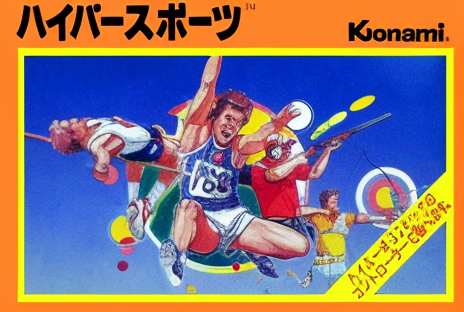
Hyper Sports: Konami Classic Famicom Title
Hyper Sports, known internationally as Track & Field II, is Konami’s follow-up to the landmark Hyper Olympic athletics compilation, ported to the Famicom console from its original arcade release. Building upon the multi-event sports template invented by the first title, Hyper Sports introduces brand-new athletic disciplines, refined qualifying rules and adjusted event physics to raise overall challenge. As Konami’s flagship athletics sequel, the Famicom conversion extended the company’s popular sports franchise and provided Famicom households with expanded competitive multiplayer sporting action suitable for large family gatherings throughout the mid 1980s.
The cartridge contains multiple distinct track and field events, each requiring unique control techniques. Available challenges include swimming, skeet shooting, triple jump, weightlifting, pole vault and archery. Sprint and strength-based disciplines demand rapid repeated button tapping to build power meters, while precision events such as archery and skeet shooting rely on careful timing and cursor positioning rather than frantic tapping. Every event features minimum qualifying thresholds; participants must meet or exceed benchmark results to advance through the tournament structure.
Two primary play configurations support different gathering sizes. Single-player mode lets athletes attempt to clear all event qualifiers in sequence while chasing personal best records. Alternating two-player mode enables head-to-head competition, where participants take turns attempting each discipline and compare final results to decide overall victors. This turn-based multiplayer design made Hyper Sports extremely popular for social contests among Famicom owners.
Konami’s Famicom port carefully recreated arcade power accumulation physics and timing windows for every discipline. Minor tuning adjusted tapping sensitivity to suit home console controller input, ensuring consistent results between arcade and home play. Visual presentation uses clean athletics stadium backdrops and clearly animated athlete sprites, with distinct visual feedback for successful jumps, lifts and accurate shots.
Audio design features upbeat stadium-themed background music for each discipline, alongside crowd cheer effects and discrete success or failure chimes. Varied musical themes prevent monotony when cycling repeatedly between different events during extended multiplayer sessions.
Strategically, mastery requires learning unique control rhythms for every separate sport. The tapping cadence ideal for weightlifting differs from sprint swimming, and precision events demand calm measured input instead of rapid button presses. Casual players often struggle to adapt control style between disciplines, while dedicated competitors memorise optimal input patterns for every available challenge.
Historically, Hyper Sports reinforced Konami’s position as the leading developer of multi-event athletics compilations on 8-bit hardware. The franchise proved that sports sequels with expanded event rosters could sustain consistent consumer demand, influencing numerous Olympic-themed game series across multiple console generations afterward.
For contemporary Famicom retro audiences, Hyper Sports remains excellent casual multiplayer software. The wide event selection prevents rapid repetition, and alternating turn-based competition works perfectly for mixed-age groups. As Konami’s definitive second athletics compilation release on the Famicom platform, Hyper Sports occupies an important complementary position alongside the original Hyper Olympic within 8-bit sports game history.