
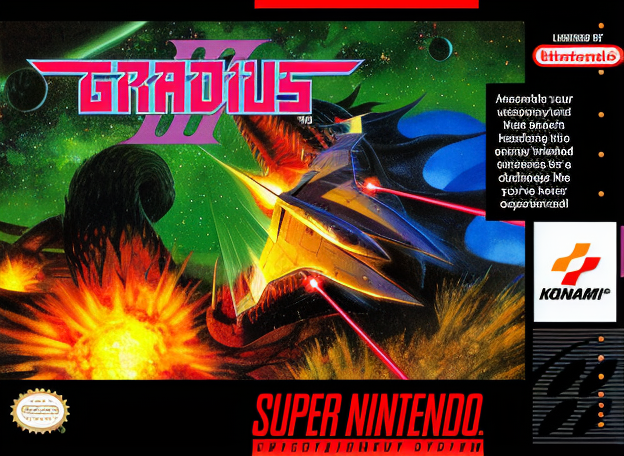
Gradius III (1990)
Gradius III, known in Japan as Gradius III: Densetsu kara Shinwa e (Legend to Myth), is a legendary horizontal-scrolling shoot 'em up game developed and published by Konami. Released for the Super Famicom on December 21, 1990, it was an ambitious home conversion of the arcade classic released earlier that year. The game continues the epic space opera of the Vic Viper starship as it battles the relentless Bacterion Empire across seven galaxies. The SNES version was particularly notable for being one of the first titles to utilize the console's hardware scaling and rotation capabilities, delivering a near-arcade experience with stunning visual effects, massive multi-segmented bosses, and some of the most intense bullet-hell patterns ever seen in early 16-bit gaming.
Core Gameplay and Weapon Customization
The game retains the iconic power-up system that defined the Gradius series: players collect energy capsules from destroyed enemies to fill a meter that allows them to select upgrades in a specific order. The upgrade path includes Speed Up (increases ship velocity), Missile (fires downward toward ground targets), Double (forward and diagonal shots), Laser (powerful concentrated beam), and the legendary Option (also known as "Multiples") – glowing orbs that follow the ship and mimic its firepower, significantly increasing damage output. Gradius III introduced the "Edit Mode," a revolutionary feature for the time, allowing players to customize their own weapon loadout before starting the game. This system gave players unprecedented control over their playstyle, enabling them to prioritize speed, firepower, or defensive capabilities, and added deep replayability as players experimented with different configurations.
The game features seven main stages, each with distinct visual themes ranging from organic biospheres to mechanical fortresses, crystal caverns, and the infamous "Crystal Labyrinth" that tests the player's memory and reflexes. The difficulty is notoriously brutal, with the SNES version actually being harder than the arcade original in some sections due to tighter collision detection and faster enemy bullets. Bosses include the return of the gigantic brain-like "Big Core" ships, the colossal "Golem" boss that fills the screen, and the dreaded "Bacterion" final boss that requires precise pattern memorization to defeat. The game also includes a unique "Moai" stage, paying homage to Easter Island statues, which has become a recurring motif in the series and a fan-favorite challenge.
Technical Feats and Legacy
Gradius III was praised for its breathtaking soundtrack composed by Miki Higashino and Konami's sound team, featuring complex symphonic arrangements that pushed the SNES's SPC700 audio chip to its limits. The game also utilized the SNES's Mode 7 for pseudo-3D boss introductions and special effects, creating a cinematic presentation that impressed players and critics alike. Despite its crushing difficulty, the game became a commercial success, selling over 500,000 copies in Japan alone and establishing the Super Famicom as a serious contender for arcade-quality ports. The game spawned numerous sequels, including Gradius Gaiden on the PlayStation and Gradius V on the PS2, and the series remains a cornerstone of the shmup genre. Interestingly, a rumored secret "Konami Code" variant exists for this game, though it has never been officially confirmed, sparking decades of debate among dedicated fans. Gradius III holds a special place in the hearts of retro gamers as a testament to the era when arcade difficulty and home console accessibility collided, creating an experience that was both punishing and deeply rewarding for those who persevered.