
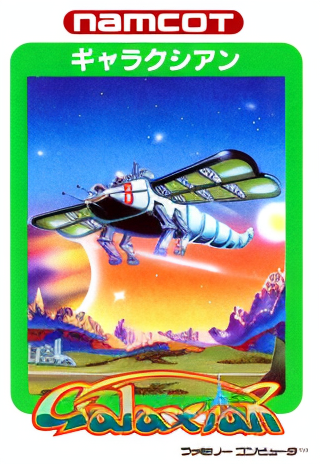
Galaxian: Namco Classic Famicom Title
Galaxian is a pioneering fixed-screen space shooter developed by Namco, ported faithfully to the Famicom console after finding massive success as a 1979 arcade cabinet. As the direct spiritual successor to Space Invaders, Galaxian introduced numerous critical innovations that redefined the shooting genre, and its arrival on the Famicom allowed Japanese households to experience this landmark arcade title without constant visits to coin-operated amusement centres. The Famicom conversion marked one of Namco’s earliest third-party releases for Nintendo’s new home platform, laying the foundation for Namco’s long-running partnership producing high-quality arcade ports and original games for the Famicom library throughout the 1980s.
The core gameplay follows the template of classic alien invasion shooters. Players control a small starfighter positioned along the bottom edge of the screen, able to move horizontally and fire upward to destroy incoming alien enemies. Rows of alien craft hover at the top of the display, but unlike the stationary invaders seen in earlier titles, Galaxian introduced dive attack mechanics. Individual alien ships break away from formation, swooping down along curved trajectories toward the player’s vessel. These diving enemies move faster and pose greater threat than stationary formation members, requiring players to balance shooting stationary targets while tracking fast incoming dive attacks simultaneously.
Multiple varieties of alien opponents appear during each wave. Standard Galaxian fighters form the bulk of each formation, while distinct flagship enemies occasionally deploy alongside them. Destroying flagships yields significantly higher score bonuses, encouraging risk-taking shots against fast-moving dive craft. Each completed wave advances difficulty; alien dive frequency increases, formation movement accelerates, and enemy attack patterns grow less predictable. Players start with a limited stock of reserve starfighters, and the game concludes once all craft are lost to enemy collisions or incoming enemy projectiles.
A key tactical nuance involves ammunition management. The player’s ship can only fire a limited number of projectiles on-screen at any one time. Holding constant fire results in slow projectile refresh rates, while measured firing allows steady continuous coverage. Skilled players learn to pace shots to maintain consistent defensive fire without exhausting available projectiles, separating casual participants from high-score competitive enthusiasts.
Namco’s Famicom port carefully translated arcade visuals and behaviour to 8-bit hardware. Sprite flickering limitations of the Famicom required minor optimisation during dense enemy dive sequences, yet all core enemy AI, dive trajectories and scoring rules remain true to the arcade original. Colour palette adjustments recreate the vivid space backdrop and multi-coloured alien formations as closely as Famicom hardware permits. The iconic arcade sound effects and looping musical themes are adapted to the Famicom sound processor, preserving the tense, energetic atmosphere of the coin-operated cabinet.
Historically, Galaxian revolutionised arcade shooter design. Prior to its release, alien invasion games relied almost entirely on slow, horizontally shuffling stationary enemy formations. Dive attack mechanics added dynamic three-dimensional feeling to fixed-screen shooting, creating tension and unpredictability that Space Invaders could not match. The design innovations pioneered in Galaxian would carry over into its sequel Galaga, also ported to Famicom, and influenced nearly every space shooter created throughout the 1980s.
For contemporary Famicom retro collectors, Galaxian stands as an essential early arcade shooter port. It represents the transition phase between primitive early invasion games and the more dynamic action shooters that dominated mid 1980s arcades. Simple to learn yet difficult to master, the cartridge delivers authentic golden-age arcade shooting action, serving as a vital historical document and reliably entertaining casual and hardcore retro players alike on authentic Famicom hardware or accurate emulation platforms.