
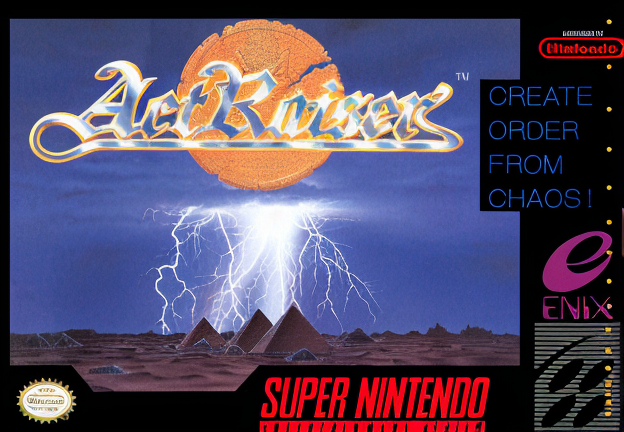
ActRaiser (1990)
ActRaiser, known in Japan as ActRaiser (アクトレイザー), is a pioneering action-platformer and city-building simulation hybrid developed by Quintet and published by Enix (now Square Enix). Released on December 21, 1990 for the Super Famicom and later in North America in 1991, the game is widely celebrated for its unique genre-blending formula, which alternates between two distinct gameplay modes: side-scrolling action stages and top-down simulation segments. The game's narrative follows a nameless "Master" (implied to be God or a divine being) who has been weakened by the demonic ruler Tanzra, and must reclaim his former power by guiding human civilization across six different lands while personally descending to fight monstrous creatures in his angelic warrior form.
Dual-Gameplay System: Action and Simulation
The game is divided into six main worlds, each representing a different historical or mythological civilization such as a Greek-inspired coastal kingdom, an Egyptian desert realm, a Nordic snowy tundra, and a Chinese-inspired mountain region. Each world begins with a top-down simulation phase where the Master, in his divine form, flies over the land and shoots arrows to destroy monster lairs, clearing the way for human settlers. Players must then guide the population by directing them to build houses, farms, roads, and temples, all while managing resource distribution and protecting villagers from waves of monster attacks. As the population grows and their faith in the Master increases (measured by a "Faith Meter"), the player earns experience points and unlocks magical spells that aid in both the simulation and action phases. Once a certain faith threshold is reached, a giant monster appears and the action phase begins.
The action phases are classic 2D side-scrolling platformer levels, where the Master manifests as a small but agile warrior wielding a sword and shield. The combat is fluid and precise, featuring a basic slash attack, a charged spinning slash, and a defensive block that can deflect projectiles. Each level ends with a massive, multi-phase boss fight against creative mythological creatures like a giant serpent, a fire-breathing dragon, a demonic minotaur, and a colossal golem. The game's difficulty is balanced by the fact that players can earn permanent upgrades to health, magic, and attack power during the simulation phases, encouraging players to invest time in the city-building aspect to make the action stages more manageable. This symbiotic relationship between the two modes creates a rewarding feedback loop: better management leads to stronger combat capabilities, which in turn unlocks new areas and story progression.
Cultural Impact, Music, and Sequels
ActRaiser was praised for its innovative design, gorgeous 16-bit visuals, and an exceptionally atmospheric orchestral soundtrack composed by Yuzo Koshiro, which is often cited as one of the greatest video game soundtracks of all time for its dynamic transitions between peaceful simulation themes and intense battle anthems. The game also incorporated religious and philosophical themes rarely seen in mainstream titles, exploring the relationship between divinity and humanity, the morality of intervention, and the cyclical nature of civilization. A direct sequel, ActRaiser 2, was released in 1992 but controversially removed the simulation elements entirely, focusing exclusively on action-platforming, which disappointed many fans. A spiritual successor titled Sola (later renamed ActRaiser Renaissance) was released in 2021 as a full HD remaster that restored the original gameplay balance and added new content, reintroducing the classic to a new generation of players. The original ActRaiser remains a beloved classic, frequently appearing in "best games of all time" lists, and its influence can be seen in later hybrid titles like Dark Cloud, Overlord, and Dragon Quest Builders, proving that its genre-defying vision was far ahead of its time and left an indelible mark on Japanese game design philosophy.