
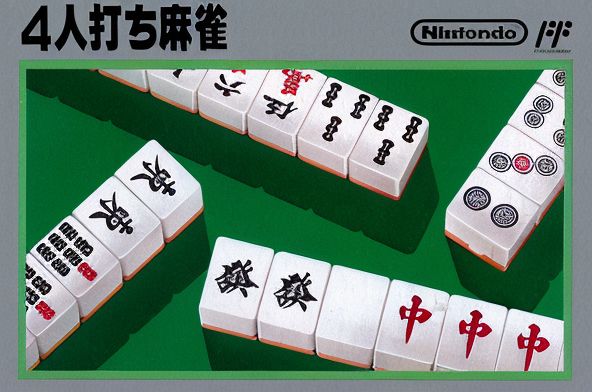
Yonin Uchi Mahjong: Nintendo Classic Famicom Title
Yonin Uchi Mahjong, known as Four Player Mahjong, is an essential traditional tabletop simulation published by Nintendo for the early Japanese Famicom console. Following the earlier two-player Mahjong release, this title fully implements authentic four-player Japanese Riichi Mahjong rules, addressing a clear demand among domestic players who wanted to enjoy complete social mahjong gatherings without assembling groups of four physical participants. Mahjong occupied a central role in Japanese household social culture during the 1980s, and dedicated digital simulators allowed flexible play arrangements, mixing human players and artificial opponents according to available participants. As part of Nintendo’s diversified non-action lineup, this cartridge helped attract adult audiences who were less interested in fast arcade shooting and platform games, expanding the Famicom’s reach as a multi-generational home entertainment system.
The game strictly follows standard Japanese Riichi Mahjong regulations. Each participant receives thirteen initial tiles, drawing one tile per turn and discarding one unwanted tile afterward. A valid winning hand is formed by four complete melds, which can be sequential number runs, matching triplets or four-of-a-kind sets, paired with one matching tile pair. Players can claim discarded tiles from rivals to complete melds, declare Riichi to place a stake on a ready hand, utilise Dora bonus tiles to boost scores and pursue rare yaku combinations that multiply final point values. This Famicom release includes adjustable optional house rules, letting users tweak round limits and special hand conditions to match local casual play customs widely used across Japan.
Multiple flexible play configurations support different gathering sizes. If one human player participates, the remaining three seats are filled by tiered AI opponents. Groups of two, three or four human participants can alternate controller usage to simulate full mahjong sessions. The artificial intelligence features graduated difficulty levels. Beginner AI makes straightforward discard choices suitable for newcomers learning tile management, while advanced AI monitors opponent discards actively, avoids dangerous tiles and times Riichi declarations strategically. This layered difficulty allows players to steadily improve their mahjong skill through repeated solo practice.
Visual design prioritises maximum clarity for long strategic matches. Every mahjong tile sprite features sharp, legible symbols, numerals and suit markings, enabling instant hand evaluation. The screen layout clearly displays each player’s discard pile, wind indicator, remaining tile stock and ongoing score totals. Unnecessary decorative animations are omitted to avoid distracting participants. Audio consists of subtle discrete tone cues triggered on tile draws, discards and winning hands, without continuous looping background music to preserve concentration during extended rounds, mirroring the calm atmosphere of real-world mahjong social play.
Successful mahjong play balances random tile draw luck with enormous strategic depth. Expert players track discarded tiles to estimate which useful tiles remain in the undrawn stock, weigh risk when discarding tiles that could complete rival winning hands and choose between building quick simple hands or pursuing high-value rare yaku. A single careless discard can immediately hand victory to an opponent, creating constant tactical tension throughout every round. Hundreds of distinct valid hand combinations ensure matches never unfold identically, extending long-term replay value significantly.
From a commercial perspective, Nintendo’s mahjong software strengthened the Famicom’s household appeal in Japan. Many adult consumers considered purchasing the console specifically to access digital versions of beloved traditional tabletop games, alongside shogi and gomoku releases. By balancing action software with thoughtful turn-based strategy titles, Nintendo differentiated the Famicom from competing hardware focused mainly on youth arcade entertainment, securing dominant market share within Japan throughout the 1980s.
For modern retro gaming enthusiasts and mahjong practitioners, Yonin Uchi Mahjong stands as a historically significant early four-player Riichi simulator. Authentic hardware and accurate emulation preserve all original rule logic and AI behaviour intact. While later mahjong releases added richer visuals and expanded rule options, this first-party Nintendo cartridge delivers reliable, faithful core mahjong gameplay. It remains a vital representative of the non-action segment of the Famicom’s launch-era software library, documenting how developers translated popular domestic tabletop culture into 8-bit interactive media.